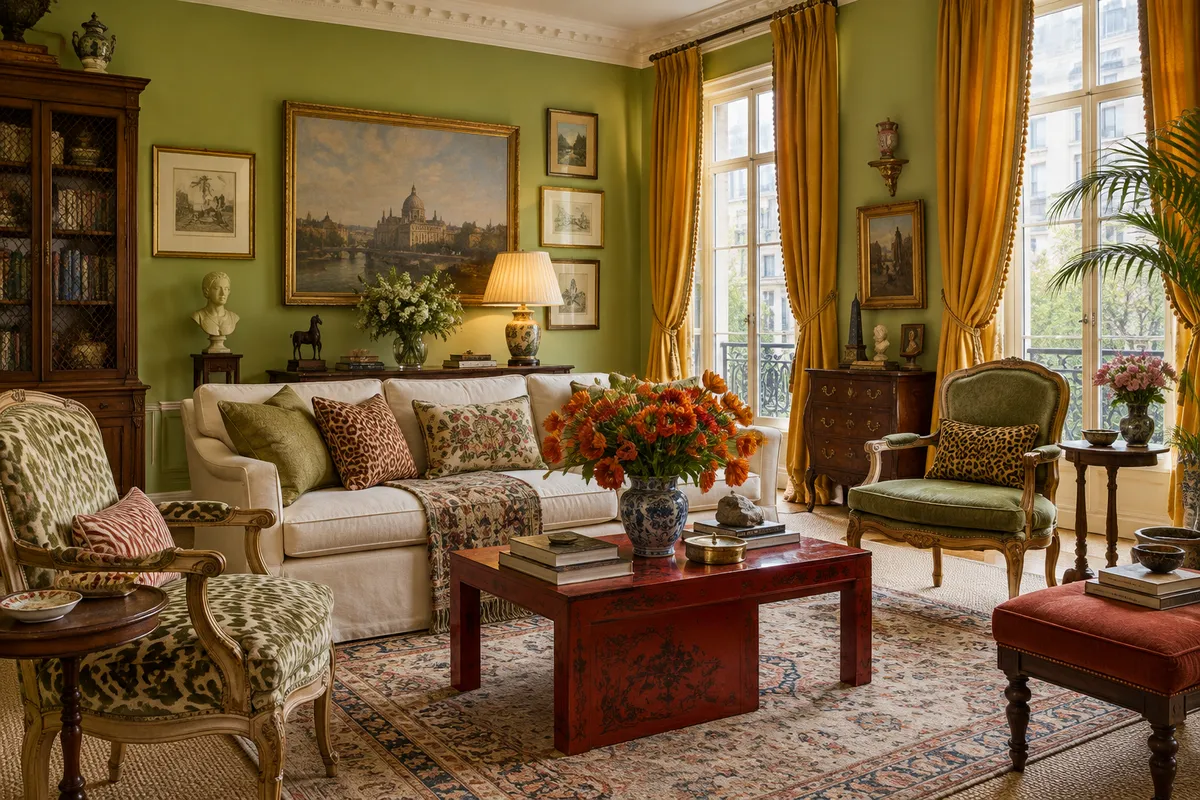
A design historian has turned a prewar New York City apartment into a vivid homage to Dior-era Paris, according to Veranda. The magazine describes a home that blends neoclassical restraint, saturated color, couture-inspired comfort, and objects collected on global travels. Its own logline promises "tiger silk velvet" and "high-voltage color" bringing the glamour of postwar Paris to the apartment. That is a lot of glamour for one set of rooms, and apparently the rooms can take it.
The Angle: Treat Your Home Like a Couture House
The most useful idea in this story is not any single paint swatch. It is the premise: a person who knows design history deeply decided to let that knowledge run the house. The result, per Veranda, is a home that reads as personal tribute rather than showroom.
It's hard not to see why that lands now. Veranda's framing is that maximalist, story-driven interiors are having a resurgence as people drift away from minimalism and toward homes that reflect scholarship, memory, and identity. A historian's apartment is close to the ideal test case: if anyone is going to justify a room full of references, it's the person who can cite them.
Two Words Doing the Heavy Lifting: Restraint and Color
The interesting tension here is in the pairing. Neoclassical restraint is the structure: the orderly, disciplined backbone of the architecture and layout. High-voltage color is the personality that gets draped over it.
That's our read, but it tracks with how the apartment is described. Restraint without color can feel like a museum. Color without restraint can feel like a clearance event. Put them together and you get something closer to a couture salon, where the bones are calm and the fabrics do the talking.
The tiger silk velvet
Veranda singles out tiger silk velvet as one of the apartment's signature touches. A fabric with that much drama is a reminder of the rule maximalists swear by: pick one or two showstopper textiles and let them lead, rather than spreading mild enthusiasm across every surface.
Comfort, couture-style
The write-up also credits "couture-inspired comfort" as part of the formula. Our interpretation: luxury here isn't just how a room looks, it's how it feels to sit in. Fashion people have always understood that a gorgeous garment still has to be worn.
The Paris Playbook, Briefly
Veranda's coverage points to two Parisian decorators as touchstones for this kind of look: Victor Grandpierre and Georges Geffroy. The details of how their work shaped this particular apartment aren't something we can lay out beyond that, but for anyone curious, those two names are a solid reading-list starting point for postwar French decorating.
The Dior connection is the other thread. Dior and Parisian interiors have an enduring pull on design fans, and the overlap between fashion and decorating is the whole premise of this apartment. If you have ever looked at a ballgown and thought "that should be a sofa," you are in good company.
What to Borrow Without a Historian's Library
You don't need a prewar building or a Dior archive to steal the logic. Based on how Veranda describes the apartment, here are the transferable moves, filtered through our own take:
- Start with a point of view. The apartment works because it is a tribute to something specific, not a mood board of everything.
- Anchor bold color with calm structure. Let architecture or classical shapes do the disciplined work so the color can misbehave.
- Mix eras on purpose. Veranda describes a blend of antiques, modern furniture, and travel finds. The common thread is that each piece earns its place.
- Collect, don't just buy. Objects from real trips carry stories that matching sets can't.
- Choose comfort as a design principle. A room you can't relax in isn't glamorous, just expensive.
Why Personal Collections Age Well
Trends in decorating rotate quickly, but a home built from a person's own research and travels is hard to date. It isn't chasing a look; it's recording a life and a body of knowledge. That is our argument, not a claim from the article, but it explains why this kind of interior feels timeless even when it is shouting in saturated hues.
There's also a gentler lesson for anyone intimidated by maximalism. You don't start with the tiger velvet. You start with the thing you actually love, and you build the room around its argument.
The Takeaway
If minimalism was a home that said nothing, this apartment is one that cites its sources. And in a year when everyone is hunting for rooms with a story, a historian who simply decorated like she knew the material may have written the most persuasive one.